Showing posts with label papa jo. Show all posts

Thursday, July 5, 2012

Misdirection


Misdirection
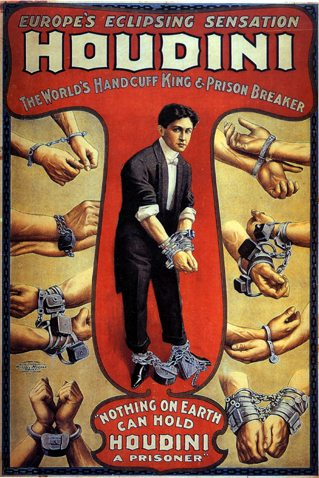
One important technique that is also, due to it's nature, frequently overlooked is misdirection.  The point of misdirection is to lead your audience to pay attention to one thing so that another thing you are doing can appear startlingly effortless.  At around :30 in the clip above notice how I play a pretty bold comping figure with my L.H. while I am reaching over to switch to sticks.  This use of misdirection makes it so that my ride cymbal beat seems to just materialize. 
Make it look easy
What is the point?
The point of musical performance as opposed to say, magic, is not to confound but to move or inspire an audience.   The importance of misdirection therefore is not illusion for illusions sake, but rather to wrap what you are doing in a shroud of effortlessness.  The experience of watching a musician struggling can range from distracting to painfully awkward for an audience, so masking difficulty with some clever misdirection can remove a barrier between your audience and your music.  In other words, judicious use of misdirection can make for a better performance.

The master at work
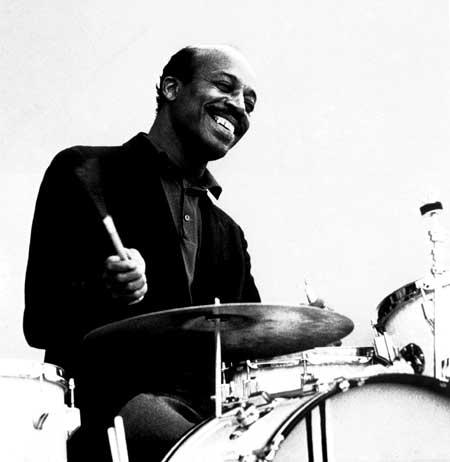
Notice in the clip below how much Papa Jo does to give the impression of effortlessness.  Everything from his posture, to what he does with his hands, to his facial expressions seem to disguise how difficult what he is playing really is.  What we the audience are left with is an amazing show:


Monday, May 21, 2012

The Evolution of Drumming

Drumming hasn't gotten better
One of the biggest misconceptions about drumming that I had as a young student of the instrument, was that the art of drumming has gone through a historical progression.  That is to say that over time drummers have elevated the craft of drumming, so that what people are playing today is infinitely more sophisticated and better than the great drummers of the past.  After all, I thought, back then drummers didn't even have double bass pedals, so how could they play anything like this?


Evolution doesn't mean improvement
This guy will cut you with brushes!
This is an easy and common mistake to make when you are learning about the drums, and I think the basic problem comes down to the misuse/misunderstanding of the word "evolution".  Essentially, evolution doesn't mean improvement, it means changing to adapt to changing circumstances.  In the world of biology this means that every organism that survives this process is highly adapted to one particular niche.  So fish are really good at swimming, and birds are really good at flying. 

In the world of drumming the exact same idea applies.  Great drummers of the past mastered the musical niche of their time and place. While it is true that Papa Jo never played any ferocious double pedal drum solos, it also true that he could play circles (forgive the pun) with the brushes around just about anyone alive today.


The reason for this is simple, Papa Jo had to play brushes to survive and thrive in the musical environment he lived in.  That in and of itself doesn't make Papa Jo a better or worse drummer than Thomas Lang, it just makes him different

Thursday, April 5, 2012

Shout Part 3: More Setting Up The Hits

If you read through the exercise in my last post on setting up hits, you may have noticed a reference to another exercise that dealt with this issue in greater depth.  So today I wanted to post that exercise, and here it is!


And here is the recording used in the exercise:


I am hoping that eventually I will be able to get all these exercises published in my book "Melodic Syncopation".  In the meantime, I hope these exercises help you as much as they have helped me!  

Monday, February 13, 2012

Papa Jo #3: Letting Your Phrases Breathe


Here is the exercise: Papa Jo #3 
Incidentally, this approach of singing your lines is an effective technique for any instrumentalist looking to get more space into their playing! 

Tuesday, December 27, 2011

Papa Jo: Dancing On the Beat


Drumming and Dance
Some of you may know that Papa Jo did some tap dancing, but finding this footage of Papa Jo playing with a tap dancer (starts at 1:48) really emphasizes how much this dance sensibility permeated everything he played.  The conversation between the the dancer and Papa Jo is so seamless it as if they are playing the same instrument.  This understanding of the relationship between the drums and dance in jazz has largely been lost, but it is beautiful and inspiring to see and hear in Papa Jo's playing!

Saturday, December 10, 2011

Papa Jo #3: Theme and variation


Theme and Variation
In my last post about Papa Jo, I discussed his use of call and response and gave you an exercise to develop some of this technique in your own playing.  In today's post I am going to focus on another element that featured prominently in both the music of Papa Jo's time and his own playing, theme and variation.  In the sophisticated John Kirby arrangement of "Blue Skies" from 1938 above you will hear some perfect examples of theme and variation.  Listen to how Kirby changes the each A section of the tune to give it a dramatically different feel, even though the basic melody stays the same.  The following exercise is from my forthcoming book "Melodic Syncopation" and is designed to help you develop theme and variation technique.  My thanks to Kenny Washington who directed me to John Kirby's music.  


Wednesday, November 30, 2011

Papa Jo #2: Call and response


Call and Response
Papa Jo and the music of his day were rich with examples of call and response. If you go to 2:15 in the wonderful video above you can see Papa Jo really having fun with this idea by having the two sides of his body talk to each other.


The following exercise from my forthcoming book "Melodic Syncopation" is designed to help you start to cultivate this technique in your own playing. 

Saturday, October 29, 2011

The two songs of jazz part 2

In the Tony Williams post yesterday I touched on the idea of the historical evolution of the drum set.  Here is a longer explanation of that concept from the introduction to my forthcoming book "Melodic Syncopation":


In addition to being designed around melodies, the exercises in this book are further categorized into seven sections, each devoted to an important drummer.  These drummers represent the evolution of jazz drumming and are all worthy of study and emulation. The exercises in each drummer’s section develop an ability that corresponds to a significant element of that drummer’s sound.

The drummers are arranged chronologically by date of birth, and as you proceed through the book you will see how each one both explores new ideas and techniques on the drums and also refers back to earlier drumming styles.  In general, the trend in jazz drumming moves from a relatively strict supporting function, with a limited focus on specific parts of the drum set (Papa Jo), all the way to an almost continuously improvised leading function, with a nearly equal treatment of all parts of the drum set (Tony Williams). 

Friday, September 23, 2011

Papa Jo #2 from "Melodic Syncopation"


Here I am playing the second exercise in the Papa Jo section of my forthcoming book "Melodic Syncopation".  This is exercise is based on the song "Cubano Chant" by Ray Bryant as played on the album "The Essential Jo Jones".  The song has a call and response structure which I play note for note on the snare drum with a bossa-nova style ostinato in my feet.  I am also singing the melody while I am playing.  If you are trying this yourself, don't worry too much about how your singing sounds/if your pitch is good.  The point is not to develop your vocal performance skills, but to make your connection to the melody of the song really concrete.  

One thing that I did differently than the recording was improvise my own response to the melodies call and then play that response throughout the form of the song.  After playing through one chorus with this response I would come up with a new one and try it again. 

This exercise is a jazz coordination exercise similar to what people often do with Ted Reed's "Syncopation", but I feel that using the melodies of jazz standards has a number of distinct advantages to that approach.  I will discuss some of these advantages in another post, but for now you can give this exercise a try.  I am hoping to have a more detailed version of this exercise published in a magazine article some time in the near future, so I will let you all know when that happens so you can check it out.