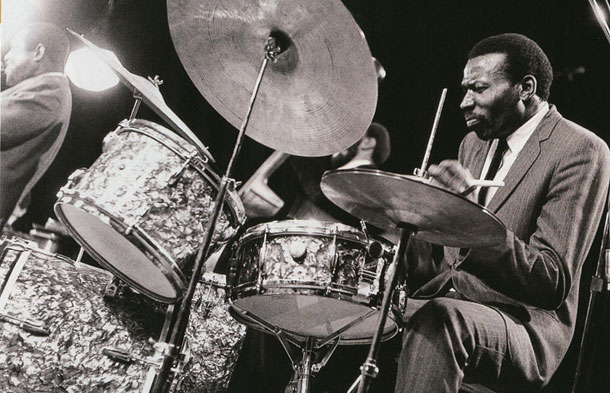
Modern Drummer Interview
In an earlier post I focused on a video interview where Elvin explains how he would embellish a melody on the drums. Today I wanted to continue to develop this theme of using the melody as the basis for improvisation with an excerpt of the Modern Drummer interview from July 2002.
The interviewer in this article was the great John Riley, and the whole thing is incredible, but I want to share a particularly relevant exchange:
 |
| John Riley |
Riley: When some people solo, they string together a bunch of licks. Other people play off of the form and melody, or the last motif of the previous soloist, or the emotion of the moment. When I listen to your soloing, I always hear an intimate relation with the melody, but with great embellishment. What's your philosophy?
Elvin: I think the structure of the composition is very important to know and to learn. You have to play within the context of the composition and interpret the composition in a way that the composer envisioned it. I think about that more than anything else.
If you are playing in a group and understand the composition, you can hear what's necessary as far as what you can do to embellish what the soloists are doing. If you have an opportunity to play a solo, understanding the structure allows you to play a solo that references that structure. What you play makes sense that way.
 |
| Wisdom from Monk |
If everybody is playing the same composition, usually it comes out pretty good. For example, Thelonious Monk heard some fellow playing a solo once. Monk was very sparing with his words; he didn't talk much. Monk said, "That was a nice solo. But it was the wrong tune." [Laughs]
Riley: So you're always singing the melody in your head?
Elvin: I hope I am. I try to make sure that I'm in the same place as everybody else.
That wonderful line of Monk's reveals so much about what makes a drum solo work or not. If you evaluate your own playing, do you feel like your soloing is a natural extension of the song you are playing, or is it totally unrelated? Being able to play your instrument is great, but if you can't make a solo connect with a song in a meaningful way, you are cut off from the life of the music. As Elvin would put it, connecting your soloing to a song is what makes it "make sense".

